Ditapis dengan

Extraordinary evil, ordinary crime: a framework for understanding transitiona…
The international debate about the use of prosecutions in transitional justice has focused on the conditionas that permit prosecuting those who commit human rights violations. Assuming that the analogy of extraordinary evil to ordinary crime is an appropriate framework within which to examine transitional justice.
- Edisi
- -
- ISBN/ISSN
- -
- Deskripsi Fisik
- 58 hal.
- Judul Seri
- -
- No. Panggil
- INT XV.00 Auk e
Change, participations and reparations
Conventional views of legal change empasize the values of certainty and reliance, and therefore hostile to explicitly retroactive laws. Put differently, reparations involve wealth transfers where behavioral, or potential anticipation, effects normally associated with compesation related to legal change are absent. The loser is hardly compensated even
- Edisi
- -
- ISBN/ISSN
- -
- Deskripsi Fisik
- 39 hal.
- Judul Seri
- The Columbia Law Review, 1999
- No. Panggil
- INT XV.00 Lev c
The duty of punish past abuses of human rights put into context: the case of …
Orentlicher concentrates on question of morals and law, and infers some conclusion about duty selectively to prosecute past violations of human rights. Beginning with the moral dimension, the extent of the duty of a government seletively to prosecute past human rights abuses depends, of course, on the theory that underlies the justification of punishment.
- Edisi
- -
- ISBN/ISSN
- -
- Deskripsi Fisik
- 19 hal.
- Judul Seri
- Yale Law Journal
- No. Panggil
- INT XV.00 Nin d
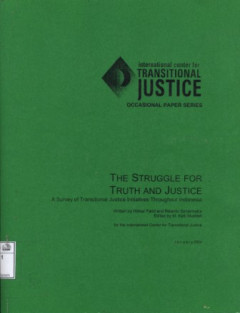
The Struggle for truth and justice: a survey of transitional justice initiati…
Buku ini mengenai keadilan di masa transisi di Indonesia. Mencakup upaya2 yang dilakukan untuk mengungkap pelanggaran ham di masa lalu, badan2 yang terlibat dalam upaya pengungkapan itu, baik badan pemerintahan maupun lembaga swadaya masyarakat.
- Edisi
- -
- ISBN/ISSN
- -
- Deskripsi Fisik
- 117 p.
- Judul Seri
- Occasional Paper Series
- No. Panggil
- 320.011 HIL s

Truth and reconciliation: obstacles and opportunities for human rights
- Edisi
- -
- ISBN/ISSN
- 90-6463-104-2
- Deskripsi Fisik
- 173 p.; 21 cm.
- Judul Seri
- -
- No. Panggil
- 341.481 DAA t
- Edisi
- -
- ISBN/ISSN
- 90-6463-104-2
- Deskripsi Fisik
- 173 p.; 21 cm.
- Judul Seri
- -
- No. Panggil
- 341.481 DAA t
Unspeakable truth: facing the challenge of truth commissions
Kebenaran yang tidak terucapkan, merupakan buku mengenai komisi kebenaran dan rekonsiliasi. komisi yang didirikan dengan tujuan mengungkap pelanggaran yang terjadi di masa lalu.
- Edisi
- -
- ISBN/ISSN
- 0-415-92477-4
- Deskripsi Fisik
- 353 p.
- Judul Seri
- -
- No. Panggil
- 340.3 PRI u
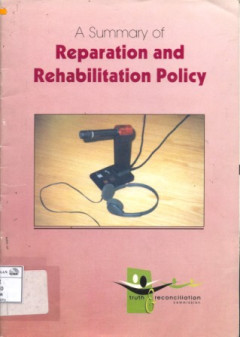
A summary of reparation and rehabilitation policy: including proposals to be …
- Edisi
- -
- ISBN/ISSN
- -
- Deskripsi Fisik
- 21 p.; 28 cm.
- Judul Seri
- -
- No. Panggil
- R 920 SUM
- Edisi
- -
- ISBN/ISSN
- -
- Deskripsi Fisik
- 21 p.; 28 cm.
- Judul Seri
- -
- No. Panggil
- R 920 SUM

Transitional Justice
- Edisi
- -
- ISBN/ISSN
- 0-19-510064-6
- Deskripsi Fisik
- 291 p.
- Judul Seri
- -
- No. Panggil
- 341.690 268 RUT t
- Edisi
- -
- ISBN/ISSN
- 0-19-510064-6
- Deskripsi Fisik
- 291 p.
- Judul Seri
- -
- No. Panggil
- 341.690 268 RUT t
Transitional justice and the rule of the law in the new democracies
- Edisi
- -
- ISBN/ISSN
- 0-268-04202-0
- Deskripsi Fisik
- xvii, 306 p.; 25, 5 cm
- Judul Seri
- -
- No. Panggil
- 341.690 268 TRA
- Edisi
- -
- ISBN/ISSN
- 0-268-04202-0
- Deskripsi Fisik
- xvii, 306 p.; 25, 5 cm
- Judul Seri
- -
- No. Panggil
- 341.690 268 TRA

Transitional Justice: How Emerging Democracies Reckon With Former Regimes : L…
- Edisi
- Volume 3
- ISBN/ISSN
- 1-878379-47-X
- Deskripsi Fisik
- xxxii, 834 p.; 25,5 cm
- Judul Seri
- -
- No. Panggil
- 320.011 TRA Volume 3
- Edisi
- Volume 3
- ISBN/ISSN
- 1-878379-47-X
- Deskripsi Fisik
- xxxii, 834 p.; 25,5 cm
- Judul Seri
- -
- No. Panggil
- 320.011 TRA Volume 3
 Karya Umum
 Filsafat
 Agama
 Ilmu-ilmu Sosial
 Bahasa
 Ilmu-ilmu Murni
 Ilmu-ilmu Terapan
 Kesenian, Hiburan, dan Olahraga
 Kesusastraan
 Geografi dan Sejarah